Chinese


Spiral Chute Introduction
The Spiral Chute is a high-efficiency gravity concentration device designed for the separation of fine-grained heavy minerals such as gold, zircon, ilmenite, rutile, monazite, tin, tungsten, and chromite in the size range of 0.02–0.5 mm.
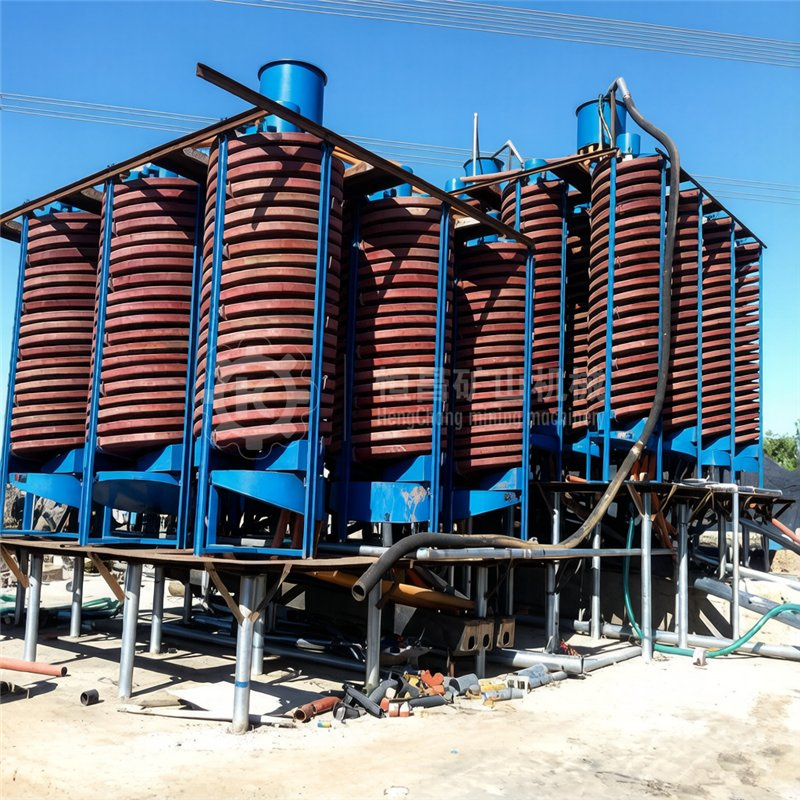
A Spiral Chute is a gravity concentration device widely used for the separation of fine-grained heavy minerals such as tungsten, tin, tantalum-niobium, ilmenite, zircon, gold, and rare earth minerals. It is typically made of fiberglass-reinforced plastic (FRP) with a wear-resistant polyurethane or epoxy lining. No power, no moving parts, and no wash water are required—only gravity and slurry flow.
Working Principle
The Spiral Chute operates on the principle of gravity concentration combined with centrifugal force stratification. Prepared slurry is introduced at the top of the spiral trough and flows downward along the helical channel without the need for wash water or external power. As the pulp spirals down, heavier mineral particles migrate toward the inner, slower-moving section of the trough due to their specific gravity, while lighter gangue minerals are carried outward by the centrifugal force and water flow. This differential movement creates distinct layers, allowing the concentrate, middlings, and tailings to be automatically discharged through separate ports at the bottom.
The Spiral Chute offers the following advantages:
- No moving parts and zero power consumption, as it operates entirely by gravity.
- Compact footprint with high processing capacity, making it suitable for large-scale operations.
- High allowable feed density and no wash water required, resulting in significant water savings.
- Low maintenance and easy operation, with stable separation performance under varying conditions.